

The product
Salame di Suino Nero dei Nebrodi
Salami produced with meat from native Sicilian black pigs
Code:
80223
Country of origin:
Italy - Sicily
Weight:
500 g approx
Minimum order:
1 piece
| Description | Salami made with meat from Nero dei Nebrodi pigs reared in the wild in Sicily, a Slow Food Presidium |
|---|---|
| Appearance | The texture is medium coarse, the streaks of fat are white and the meat is pink-red in colour, with visible peppercorns |
| Taste | Mild, with notes of dried fruit and mature meat, the spiciness is delicate and enhances the rustic flavour of the meat |
| Our selection | Nero dei Nebrodi pigs are reared en plein air, in accordance with the Presidium's regulations. Only typical "zimme", small structures made of stone, branches and earth, are used to shelter the pigs. These are ideal for the animals' wellbeing and have a low environmental impact |
| Suggestions | Serve as an aperitif or appetiser on a slice of bread; ideal with dry, full-bodied red wines |
| Weight | 500 g approx |
|---|---|
| Packaging | Unpacked |
The producer
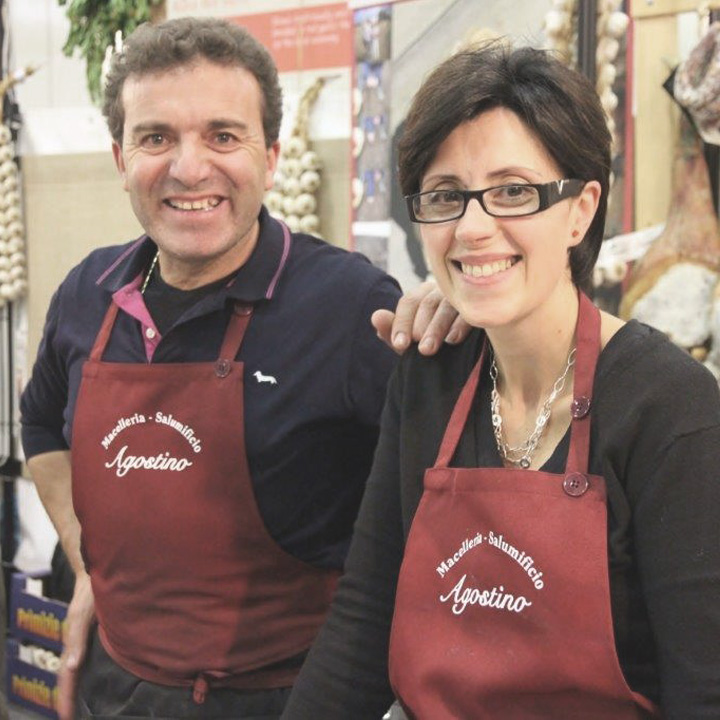
Agostino - Mirto (ME) - Sicily
Why we chose them
Luisa e Sebastiano Agostino Ninone started their own farm in 1986 where they raise their herd of Nebrodi Black Pigs and also process the meat to
produce a selected variety of traditional local products.
Nebrodi black pig is a wild native race of Sicily. Pigs are medium-small and have a black coat with stiff bristles forming a kind of mane along their
back.
The herd of Agostino is raise in a park of about 100 hectars, full of oaks, pastures where pigs can live wildly, eating acorns, chestnuts and tubers.
The pigs are raised in semi-wild or wild conditions in the forests and meadows of the Nebrodi mountains, in the north east of Sicily. They are fed
supplementary with broad beans and barley and kept in small huts called "zimme" only when absolutely necessary or when giving birth.
The Nebrodi black pig is a Slow Food Presidium, that produces an excellent meat: the extinction of this pig breed would represent a serious loss, in
terms of its genetic heritage but also for the local economy and gastronomy. According to the Presidium, pigs have to be raised for at least two years
"en plein-air".
See also:
You might also be interested to the following products
-
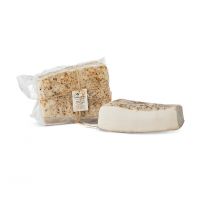
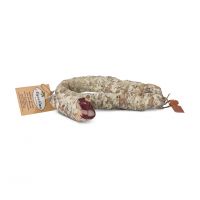
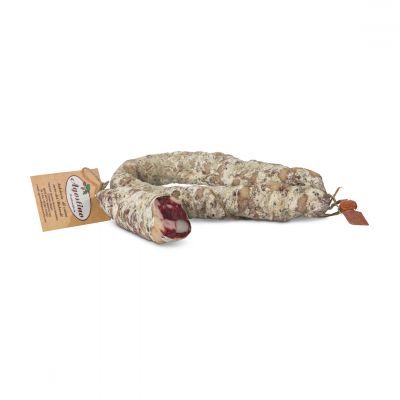 Salsiccia curva di Suino Nero dei NebrodiCured sausage produced from Nebrodi Black Pig in Sicily
 -
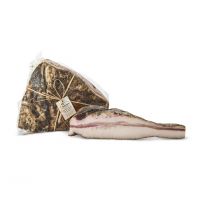
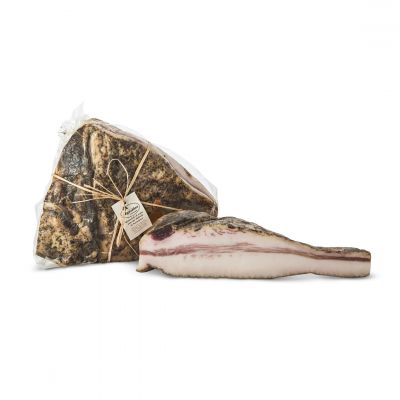 Guanciale di Suino Nero dei NebrodiCheek lard from Nebrodi Black Pig produced in the North East of Sicily